Chart to play with
Best time to climb Tiger Cave Temple, month by month
Twelve months at the stairs
Rain, warmth and daylight through the year
Choose a month to compare sunset and day length at Tiger Cave Temple, with the usual warmth and rain at the nearest station and what to plan around.
Sunset
Jan
January is dry, with 23 mm of rain and an average high of 32.7 °C.1
Feb
February is the driest month, with 5 mm of rain and an average high of 33.8 °C.1
Mar
March is the hottest month on the stairs, with an average high of 34.1 °C.1
Apr
April brings 117 mm of rain over 8 wet days as the first heavy showers arrive.1
May
Jun
June averages 269 mm of rain.1
Jul
July averages 268 mm of rain over 17 wet days.1
Aug
August averages 334 mm of rain.1
Sep
September is the wettest month, with 347 mm of rain, and TAT says it bears the brunt of the monsoon.1,2
Dec
December is drier, with 66 mm of rain and an average high of 31.9 °C.1
Sunset is worked out for the 15th of each month on Thailand time, which has no summer time. Day length is for the temple area; temperatures and rain come from the NOAA station at Phuket, 63.7 km away, 1991 to 2020 (Phuket Airport and Trang supply a few months).
The best time to climb Tiger Cave Temple is the dry stretch from December to March, early or late in the day. Rainfall, heat and daylight are lined up month by month below, with the best hour in mind.
Editorial team, tigercavetemple.top · Updated November 16, 2026 · Takes 7 min
Basics
- Best monthsAt the nearest station December brings 66 mm of rain and February just 5 mm, the driest stretch of the year.1,1
- Hottest monthsAverage daily highs peak at 34.1 °C in March and 34 °C in April.1,1
- Wettest monthsSeptember averages 347 mm of rain over 17 wet days, and the authority says it bears the brunt of the monsoon.1,2
- High seasonThe authority says the Andaman coast enters its high season from November onwards.3
- Best hourAim for an early or late start on the stairs; the day sold here schedules the temple after the pools.
The short answer: the dry months from December to March
If you can pick the month, pick one between December and March. At Phuket, 63.7 km away and the nearest station with a long record, rainfall averages 66 mm in December, 23 mm in January, 5 mm in February and 52 mm in March.1,1,1,1 Wet days follow the same curve: 5 in December, 2 in January, 1 in February and 4 in March, counted as days with at least 2.5 mm.1,1,1,1
Dry also means hot. Average daily highs climb from 31.9 °C in December to 32.7 °C in January, 33.8 °C in February and 34.1 °C in March.1,1,1,1 A staircase in 34 °C air is hard work, and the time of day weighs as heavily as the month in this stretch of the year, with water and a slow pace as necessities rather than options.
The tourism authority describes the same window in its own words. The authority puts the start of the Andaman high season at November and suggests booking accommodation up to a year ahead for the peak from late December to early January.3,4 The two sources do not conflict: the station shows November as still wet, and the authority's high season is a tourism calendar, not a rainfall table.
Wet months: how rain treats the stairs
From May the station records climb sharply: 229 mm in May, 269 mm in June, 268 mm in July, 334 mm in August, 347 mm in September and 337 mm in October.1,1,1,1,1,1 November still brings 217 mm over 12 wet days before December dries out.1 The tourism authority dates the southwest monsoon to May to October and says September bears the brunt of the rains.2
Rain on a concrete staircase is mostly a question of grip and timing. One TAT piece describes monsoon rain as short, intense bursts lasting a few hours around midday, while another says 1-2 hours of rain, falling mainly late in the day.5,6 The two descriptions differ, so treat the hour of rain as unpredictable and carry a light rain layer.
Torrential showers, the authority adds, are likely to affect mountain trekking.7 The temple stairs are not a mountain trek, but the logic carries over: a steep staircase after heavy rain is a slippery one, and a guide may change the order of the day to keep the climb out of a storm. The same authority frames the rainy season as good for waterfalls and jungle treks, which fits the pools and the springs.8
Through the year
Rain and heat through the year near Krabi
- Jan12.3 h
- Feb12.1 h
- Mar11.9 h
- Apr11.7 h
- May11.5 h
- Jun11.4 h
- Jul11.4 h
- Aug11.6 h
- Sep11.8 h
- Oct12.0 h
- Nov12.2 h
- Dec12.3 h
Displayed: sun-free hours in mid-month, and days with a minimum of 2.5 mm of precipitation. NOAA, station Phuket (temperatures and rainfall for 7 months, rainfall only for 5 months), Phuket Airport (3 months) and Trang (2 months), 1991 to 2020.1
Month by month on the stairs
December to February is the sweet spot for most readers who want to climb: little rain and highs between 31.9 °C and 33.8 °C, a sound default if your dates are open.1,1,1 March and April are the hottest, with highs of 34.1 °C and 34 °C, and April brings 117 mm of rain over 8 wet days as the first heavy showers arrive.1,1
May to October is the green season. Highs at the station fall to 30.9 °C in September, and the stairs are cooler between showers, but the rain and the wet steps make the climb a gamble.1 November is a mixed month: 217 mm of rain and 12 wet days, with highs of 32 °C and a pick-up in tourist numbers as the high season begins.1,3
If your dates are fixed, the month alone should not stop you. A guide on a wet day can pace the group between showers, and a dry spell in the green season can give you the stairs with fewer people on them. Whatever the month, plan for the hour first, then watch the forecast from the Thai Meteorological Department, which the tourism authority tells travellers to follow.10
Pick by weather
Which month and hour fit you
Name your priority and see when the climb fits.
If I want the driest weather
February
It averages 5 mm of rain over 1 wet day at the station.1
If I want the coolest highs
September or October
If I want a late light climb
The sunset tour
It runs 4 hours from $83, with the climb as its main event.
If I want the stairs after the pools
The full day
The temple takes the last hour of the programme, after the pools and the springs.
If I want to keep my options open
A free-cancellation booking
Withdraw a full day ahead and the day sold here gives the fare back.
Which hour of the day to climb
The hour changes the climb more than the month does. In the dry season the sun is the issue, and a start before midday or a late afternoon climb keeps you out of the hottest hours. In the green season the authority's two descriptions point at the afternoon and the middle of the day as the usual time for rain, so the early morning is the safer slot.5,6
A tour day makes the choice for you. On the day sold here the temple takes the final hour, following the pools, lunch, the hot springs and a car ride of 1 hour, while pickups on a comparable day fall in a window from 8:00 AM until 8:45 AM. You reach the stairs in the later part of the day, and a day that ends with the temple has a different feel in March than in December.
If you want to pick the hour yourself, perhaps a Tiger Cave Temple sunrise or an afternoon start, the sunset tour is the nearest format built for choosing a time. The tour is 4 hours long with a 30-minute car ride, and guests are asked to bring a hat, sunglasses, water and a small towel. A private vehicle lets you set your own start, and the private options on the prices page show what that costs.
A hot-season day
How a dry-season climb day can unfold
Early start
Pickup in the morning
A comparable day begins pickups at 8:00 AM and finishes them by 8:45 AM.
Cool stretch
Pools before the heat
The Emerald Pool and the Blue Pool take 1 hour each.
Midday
Lunch for 1 hour
A break from the sun before the springs.
Warm water
Hot springs, 2 hours
Swimming at Krabi Hot Springs.
Late climb
The temple, 1 hour
The stairs end the programme, and a car ride of 1 hour takes you back.
Daylight, sunrise and sunset through the year
Krabi lies close to the equator, so daylight barely changes. Daylight at mid-month, as the station files work it out, lasts 11.7 hours in December and January, 12.1 hours in March, 12.6 hours in June and July and 12 hours in October.1,1,1,1,1,1 That is a narrow range, and in no month does the light fail early.
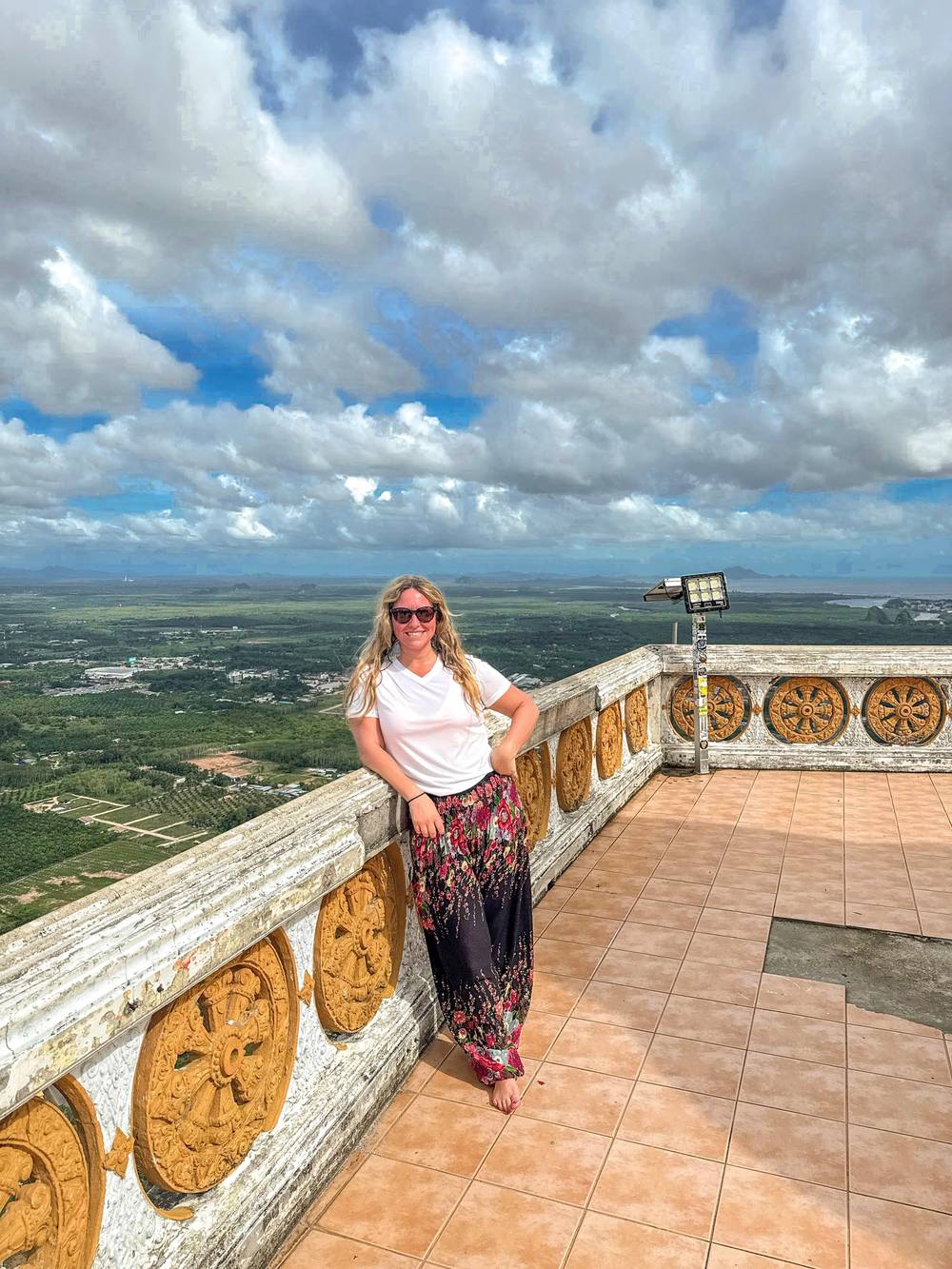
Tiger Cave Temple sunset is the part worth timing. Krabi is credited by the tourism authority with some of the most photogenic sunsets in Thailand, often lit by cloud to cloud lightning.9 A climb that ends near sunset gives you the view in warm light, but you have to plan the descent: stairs in fading light are harder, and a torch or a phone light is useful. Use the sunset tool above for month-by-month sunset times.
Sunrise is a different proposition. No tour record checked for this guide starts a climb at dawn, and no official source gives opening hours for the temple, so an early start would need an arrangement of your own. If you want it, ask a private operator whether it is possible, and make sure the answer comes with a named time for the stairs.
Video
The rainy season in South Thailand, what to expect
Travels on Toast on YouTube · The clip loads only after you tap play.
Krabi features some of the most photogenic sunsets in Thailand
Plan the month
Weather checklist for the stairs
What the season does to the pools and the hot springs
The other half of the sold day depends on the season too. The tourism authority calls the Emerald Pool, in the Khao Pra-Bang Khra Wildlife Sanctuary, swimmable, with a little cascade and a short walk upstream to the Blue Pool.11 The Outback day record adds that the Blue Pool is out of bounds during Gurney's Pitta breeding, so even a dry-season visit can miss it.
The hot springs behave differently. The authority gives the Klong Thom salt hot spring water at about 40-47°C, a temperature that does not swing with the weather the way a river does.12 A hot soak after a hot climb is not everybody's idea of a reward, and you can choose to treat the springs as a green-season treat and the pools as a dry-season one.
Rain can change the programme without cancelling the day. The jungle day warns that tide and weather may alter its programme, and the sunset tour goes ahead in any conditions. Ask whether a wet-day plan exists, and whether the order of stops can flip so that the temple comes before the pools if a storm is building.
Choosing your month
If you want the clearest conditions and can handle heat, pick January or February: they are the driest months at the station, with 23 mm and 5 mm of rain.1,1 If you want slightly cooler air and a little more rain, choose December, with highs of 31.9 °C.1 March and April are hotter and are where the first heavier showers arrive.1,1
If your trip falls in the green season, keep your plans loose. September is the wettest month, with 347 mm, and the authority says it bears the brunt of the monsoon.1,2 May to October still gives you the same temple, the same pools and a greener forest, and a day booked with free cancellation can be moved if a storm arrives.
Whichever month you choose, book the early slot, carry water and keep shoulders and knees covered for the temple. The day sold here hands the fare back when you drop out a full 24 hours ahead of departure, so you can book first and check the forecast later. The steps page covers the stairs, and the clothing page covers the dress rules.
FAQ
The short answers to your questions.
When is the best time to climb Tiger Cave Temple?
Is Tiger Cave Temple worth visiting in the rainy season?
What is the hottest month on the stairs?
Which month is wettest near Krabi?
It averages 347 mm of rain over 17 wet days at the Phuket station.1
Can I climb at sunset?
A sunset tour is a 4-hour outing that includes pickup and a 30-minute drive.
Does the tour run in bad weather?
Its record says it goes ahead in any weather, and the Outback day likewise runs rain or shine.
When does the high season start?
The authority dates the start of the Andaman high season to November.3
Sources
- NOAA · Global Summary of the Month, Station Phuket (temperatures and rainfall for 7 months, rainfall only for 5 months), Phuket Airport (3 months) and Trang (2 months) (NOAA GHCN TH000048564 (Phuket); TH000048565 (Phuket Airport); TH000048567 (Trang)), 1991 to 2020 ↩
- Tourism Authority of Thailand (TAT Newsroom) · TAT encourages travellers to check weather updates during monsoon season ↩
- Tourism Authority of Thailand (tourismthailand.org, Wayback copy) · Krabi, embrace the charm of nature, relax and unwind ↩
- Tourism Authority of Thailand (tourismthailand.org, Wayback copy) · Krabi (TAT province page) ↩
- Tourism Authority of Thailand (TAT Newsroom) · TAT encourages travellers to check weather updates during monsoon season ↩
- Tourism Authority of Thailand (TAT Newsroom) · Important information on marine tourism in Thailand during the Southwest monsoon season ↩
- Tourism Authority of Thailand (TAT Newsroom) · TAT encourages travellers to check weather updates during monsoon season ↩
- Tourism Authority of Thailand (TAT Newsroom) · Thailand: the perfect year-round destination ↩
- Tourism Authority of Thailand (tourismthailand.org, Wayback copy) · Krabi (TAT province page) ↩
- Tourism Authority of Thailand (TAT Newsroom) · TAT encourages travellers to check weather updates during monsoon season ↩
- Tourism Authority of Thailand (tourismthailand.org, Wayback copy) · 10 things to do in Krabi ↩
- Tourism Authority of Thailand (tourismthailand.org, Wayback copy) · Krabi, embrace the charm of nature, relax and unwind ↩