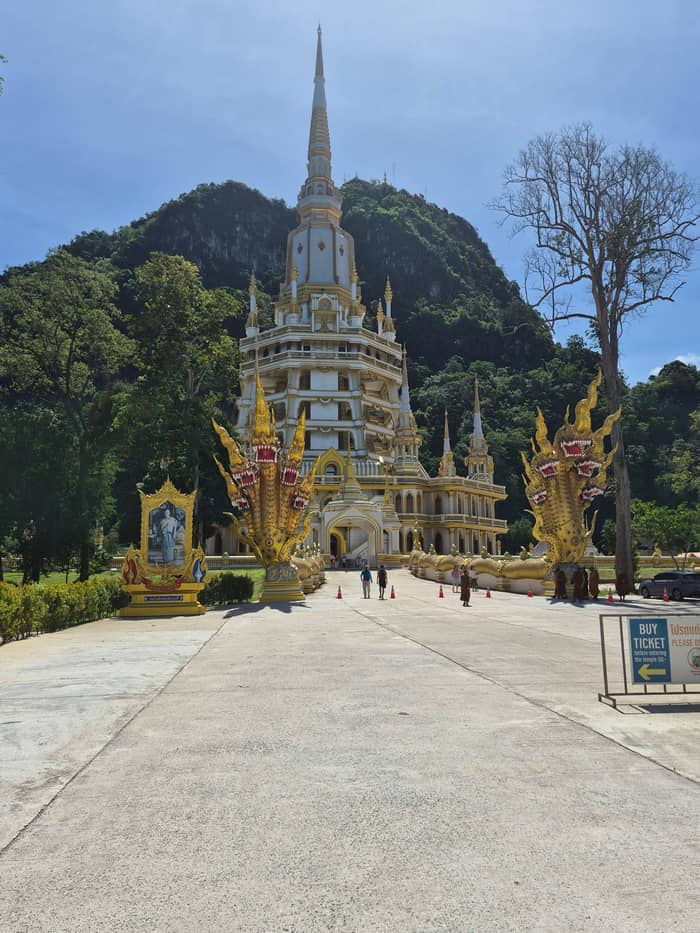
The short visit
Guided stop
Part of a long day
- Time1 hour
- LabelVisit and guided tour
- GroupLimited to 9
Size up your group price
Side-by-side: 3 options
Choose your party size and set the days built around the temple against each other.
≈
View≈
View≈
ViewFigures are GetYourGuide from-prices, translated at the ECB reference rate. The booking step shows what you pay exactly.
Several spellings, a single temple: what tourism sources say about Wat Tham Suea, what they leave out, how a working Buddhist temple expects you to behave and how the day tours handle the visit.
Editorial team, tigercavetemple.top · Updated November 16, 2026 · Takes 8 min
Basics
Wat Tham Suea is the Thai name, and the Tiger Cave Temple is the English name that tourism sources use for the same place. The Tourism Authority of Thailand writes it as the Tiger Cave Temple, Wat Tham Suea, and puts the climb at 1,260 steps, ending at a summit with a 360-degree outlook.1 Tourism Thailand lists Wat Tham Suea (Tiger Cave Temple) among the natural attractions of Krabi, next to Ban Na Teen Community and Khlong Nam Sai.2 Search for either name and you will land in the same place on the map, a little north-east of the town.
Spellings drift because Thai is written in its own script and every writer transliterates it differently. One listing for the Outback day names the temple Wat Tham Sua and calls it a Buddhist temple in a forest setting, while the site's own listing uses the spelling Wat Tham Seua and describes a hilltop temple, a Buddha statue and views of Krabi. When you book, check the stops, not the spelling, and expect any of these forms on signs, tickets and booking pages.
A word of caution on the name: Wat Tham Suea temple names turn up in more than one place in Thailand, and searches mix them up. This guide is about the temple in Krabi province, north-east of Krabi Town and about 5 km from its centre in a straight line on the map.4 Other temples or animal attractions with tiger in their names are not this site, and nothing here describes them. If a page you read talks about animals kept for visitors, it is about somewhere else.
Names and spellings
| Source | Name as written | What it says |
|---|---|---|
| TAT Newsroom | Tiger Cave Temple, Wat Tham Suea | A climb to a 360-degree viewpoint1 |
| Tourism Thailand | Wat Tham Suea (Tiger Cave Temple) | A natural attraction of Krabi2 |
| Outback day listing | Wat Tham Sua | A Buddhist temple in a forest setting |
| The site's own listing | Tiger Cave Temple, Wat Tham Seua | A hilltop temple with a Buddha statue |
| Elephants and temple listing | Tiger Cave Temple | A climb with panoramic views |
Names and descriptions as each source writes them; spellings of a Thai name in Latin letters vary between sources.1
It is worth being straight about how much is known from official pages. The Tourism Authority of Thailand counts 1,260 steps on the climb, ending at a summit with a 360-degree outlook,1 and another TAT feature has an actress describe climbing 1,237 steps on a day off.9 Tourism Thailand lists the temple as a natural attraction of Krabi.2 That is the extent of what we could read on official pages: a name, a climb, a view and a place in the province's list of attractions.
Even the name is not fixed, and one mapped record labels the summit site as the Tiger Cave Mountain Temple. Missing from the official pages is almost everything else a visitor might want: a founding date, the size of the monastic community, the tradition it follows, the history of its statues and the meaning of the name. Blogs and guidebooks give plenty of detail, but none of it could be verified against an official source, and some of it contradicts itself from site to site. This guide therefore does not repeat it. If a date or a number matters to you, ask at the temple or look for the monastery's own notice.
That honesty has a practical side. A visit to a working temple is better approached as an encounter than as a checklist of facts. Read the notices at the gate, which take precedence over any guide, follow what the people in robes and the staff ask, and treat unfamiliar details with a little humility. The rules for visitors are the same ones TAT sets out for every temple in the country, and those are the part you can rely on, and the next sections go through them.
Demand for temple days
Review counts on each listing: the site's own day 4,025, a jungle day 287, the elephants and temple day 176, the pools and temple day 82 and the Outback day 36.
The dress rule is the one that matters at the gate. For men the expectation is covered shoulders plus trousers or knee-length shorts,3 and for women a skirt reaching below the knee with a top that has sleeves.11 The site's own day repeats it with the words that shoulders, underarms, back and knees should be covered, and a sarong, scarf or sweater suggested. The half-day listing with elephants says that entry needs modest clothing.
Shoes follow a different rule. TAT expects bare feet inside a temple building, with racks or marked spots for shoes outside every temple,5 and that sandals, if worn, should have a strap at the back.12 The raised sill at most temples is for stepping over, never onto.13 Hats and sunglasses come off,14 and phones go silent.15 Treat the entrance of any hall as a line between the outside world and a place of prayer, and slow down as you cross it.
Behaviour inside is quiet and unhurried. TAT asks visitors not to speak loudly or yell,6 and rules out smoking, chewing gum and snacking while strolling around.16 If the stair has left you out of breath, rest on the way up and leave your snack at the vehicle. A wat is not a viewing platform for a crowd: even when the place is busy, your voice, your bag and your camera are the three things that you control, and the way you handle them is what the monks and other visitors will remember.
Your visit
Match what you want from the temple to the kind of stop.
If I want context from a guide
A guided stop
One listing labels the stop as a visit with a guided tour.
If I want time to look and rest
A free-time stop
One listing builds a long stop with photos and free time into its program.
If I want the temple and little else
A half day
One listing builds a half day of 3 hours around the temple and an elephant sanctuary.
If I am unsure what to wear
Follow TAT's rule
Sleeves and covered knees are asked at every temple.3
If I want to photograph the statue
Do it from the side
Never turn your back to the statue.7
If I have a monk next to me
Give space
Women keep their hands off monks and robes.10
Pick a visit
The short visit
Part of a long day
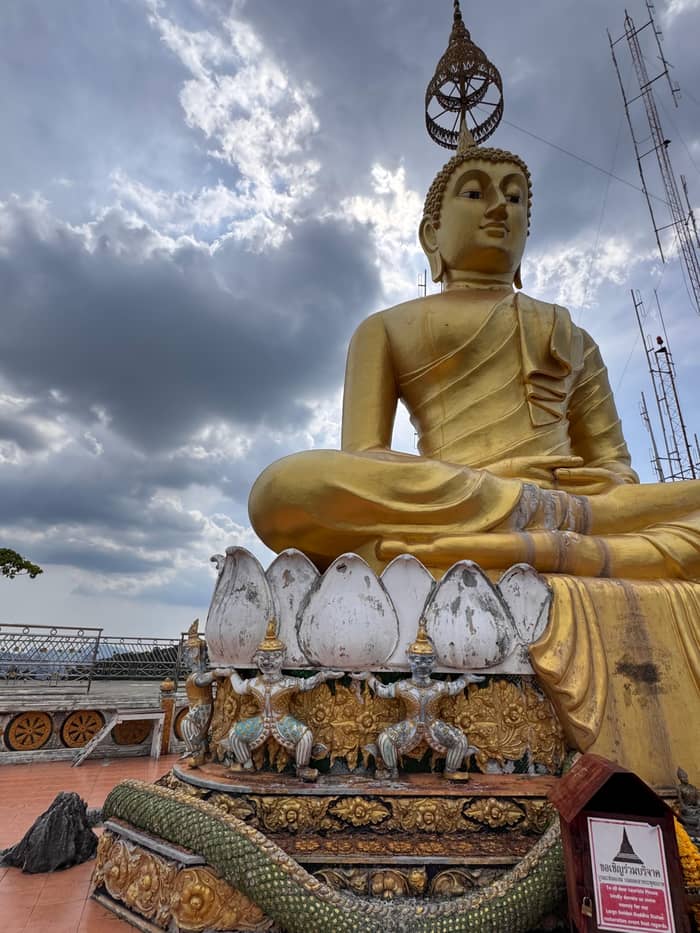
The long visit
After the pool and spa
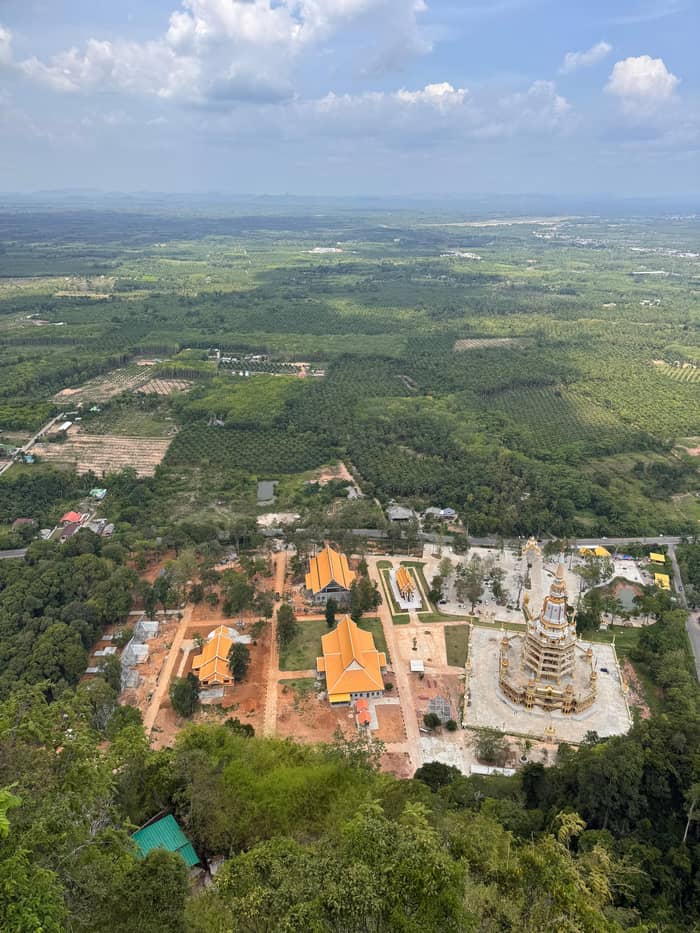
The compact visit
Temple with elephants
Monks are part of the place, not part of the scenery. TAT's note tells women never to touch a monk or what he wears, and suggests handing items over indirectly, through a man or by setting them down for the monk to collect.10 The rule applies to everyone in spirit: do not crowd a monk for a photograph, and do not block the way of anyone walking or praying. If a monk gestures for you to move, step aside and give a small bow.
TAT's list treats Buddha images as sacred: hands and pointing fingers stay away, you circle the image clockwise, and you keep your back from it,7 and that the proper way to sit in front of one is with your feet pointing away from it.17 It adds that nobody should sit or stand above the image,8 which matters at a temple whose statues are often on raised platforms. Back away a short distance before turning around, as the same TAT page suggests, rather than walking off with your back to the image.
Photography is usually allowed at Thai temples, but TAT calls it rude to stand between the camera and someone who is praying or leaving a gift.18 Donations are part of how a temple lives, and one listing mentions small cash for donations or snacks among the items to bring. We found no official donation figure, so treat any gift as voluntary and at your own discretion. Put it in the box provided, and do not hand money to anyone who does not work at the temple.
A respectful visit
At the gate
Posted rules take precedence over any guide.3
Before entering
Sleeves and covered knees.3
At the door
Barefoot into a temple building.5
Inside
Do not speak loudly or yell.6
At the statue
Never turn your back to the image.7
Leaving
Stay below the level of the image.8
Day tours treat the temple as one stop in a long programme. The site's own day gives it 1 hour, labelled as a visit with a guided tour, followed by a drive of 1 hour back to Ao Nang. A listing from another operator allows 1.5 hours, labelled as sightseeing, a walk and a hike, and the Outback day stretches the stop to 2 hours, with a photo stop, a visit and some free time written into it, after the pool and the spa. A guided stop gives you some context; a free-time stop gives you space to look, rest and take your time.
Half-day listings centre on the temple. One combines it with a sanctuary where riding is not offered, for 3 hours in all, and counts 1,237 steps, while a private city tour gives the temple 2 hours and then adds a crab statue and a fresh market at 1 hour each. A private trip for up to 9 people adds the pool and a hot spring, in 8 hours. Choose according to what else you want from the day; the temple itself is the same stop in every version, with the same rules for dress and behaviour.
Whatever the listing, the practicalities are shared. Wear the covering clothes, bring water and shoes with grip, leave the vehicle with a return time and keep your belongings light. TAT says almost all local agencies offer packages that go to the temple and the Emerald Pool,19 so there is plenty of choice, but the stop length is the number to compare. A temple stop of 1 hour is a quick look, and a stop of 2 hours is a visit; match it to how much you want from the place.
Video
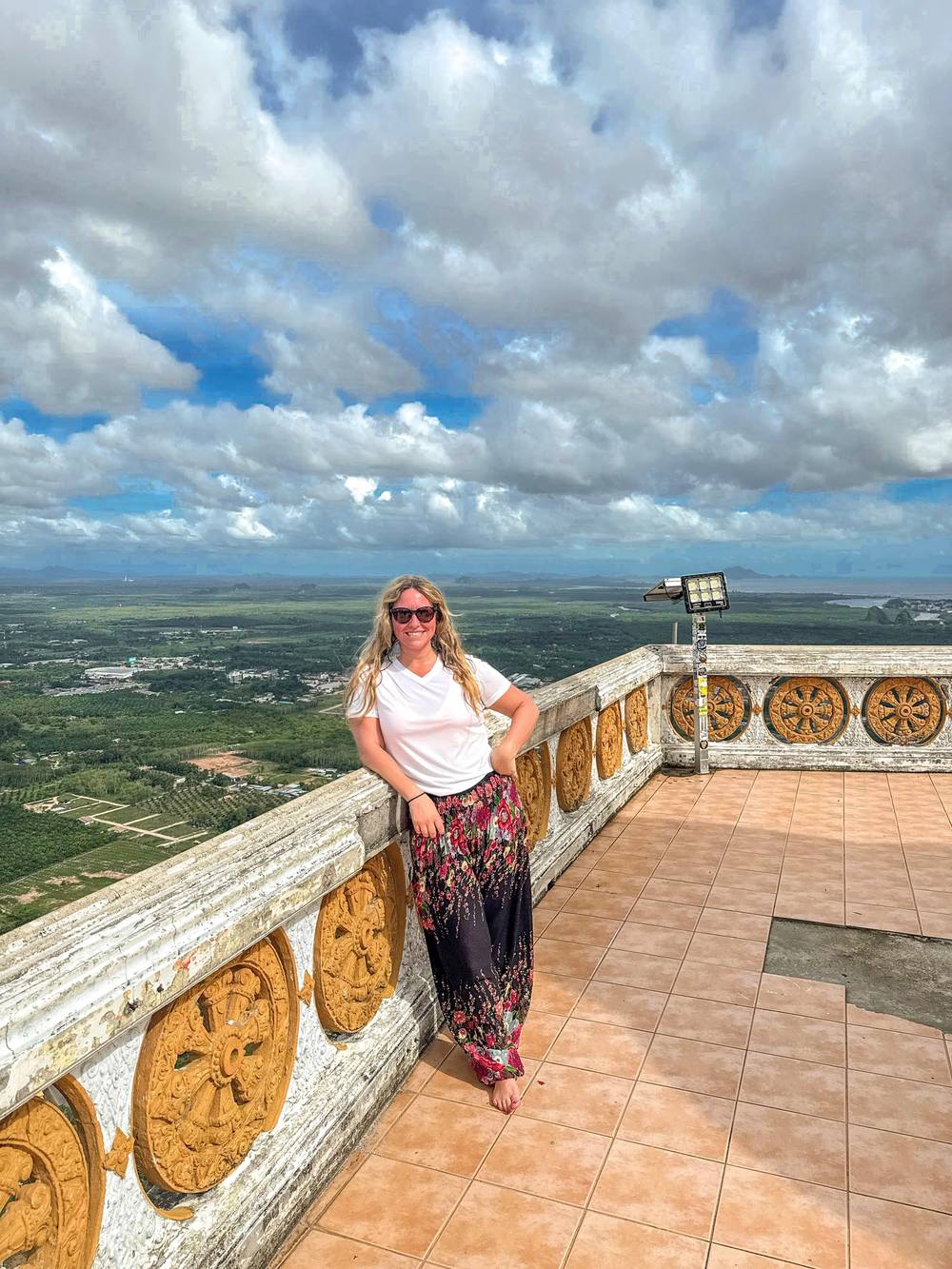
Paradise Adventures on YouTube · The clip loads only after you tap play.
Anyone entering a temple is expected to do so barefoot. Shoe racks or designated spaces to leave your shoes are found outside all temples
Before you go in
The temple is a half-day outing from the coast. TAT puts Ao Nang around 20 kilometres from Krabi Town,20 and the map puts the temple about 15 km from Ao Nang Beach in a straight line,21 close enough for a half-day outing, though driving covers more ground than the straight line suggests. A visit fits comfortably into a morning or an afternoon, with time left for a swim or a meal either side of it. The Emerald Pool and the hot springs lie much farther inland, near Khlong Thom, and TAT says the temple and the pool combine easily.22
What else you add depends on what you like. TAT's Krabi feature names the Dragon Crest Mountain trail, with its 2 hours of walking and a view over Phang Nga Bay,23 and the boat trips to Hong Island with a climb to a viewpoint.24 The temple is a different kind of stop from these: a place of worship at the top of a stair, in a forest, with a statue and a view, and with rules of behaviour that the beaches and the boats do not have.
Last, plan around the weather. Weather shapes the visit. TAT places the monsoon between May and October, with short, hard showers,25,26 and Tourism Thailand says the Andaman high season begins in November.27 Both seasons work for a visit to a temple, but the stairs are wetter in the rain and the day is hotter in the dry. Pick the hours that suit you, check the forecast and let the temple be a calm stop in a busy trip.
FAQ
Treat it as a working temple: dress modestly and follow the posted rules.3
TAT expects bare feet once you step inside.5
TAT counts blocking worshippers as rude.18
Items can be passed by putting them down for the monk to pick up.10
The site's own day gives it 1 hour, other listings 1.5 hours and 2 hours.
TAT's climb of 1,260 steps and the listings all describe the Krabi site.1
Sources
Planning the Tiger Cave climb? Ask a real person here.